
Zefeng Wood Industry: Our main products include melamine-faced medium-density fiberboard, melamine-faced particleboard, melamine plywood, plywood, construction laminated board, WPC wallboard, PVC edging strips, and stone-plastic UV board
- Tel:+86-15610632233
- Email:ceo@wbphuanghe.net

10
2025
-
10
With internal and external challenges piling up alongside iterative policy changes, how can the engineered wood panel industry anchor itself toward breakthroughs in high-end development, intelligent manufacturing, and sustainability?
Starting June 1, 2026, China will completely phase out E1-grade products in its engineered wood panel industry, marking the beginning of an accelerated reshuffling period for the sector.
With internal and external challenges piling up alongside iterative policy changes, how can the engineered wood panel industry anchor itself toward breakthroughs in high-end development, intelligent innovation, and sustainable practices?
2025-10-09 Source: China Green Times
Starting June 1, 2026, China will completely phase out E1-grade products in its engineered wood panel industry, marking the beginning of an accelerated reshuffling period for the sector.
Faced with growing demands and external pressures, how can the engineered wood panel industry break through its current challenges? At the recently held 10th World Panel Conference, delegates gathered under the theme "Whole-Chain Resonance, Quality Enhancement and Innovation," exploring potential solutions to these pressing issues.
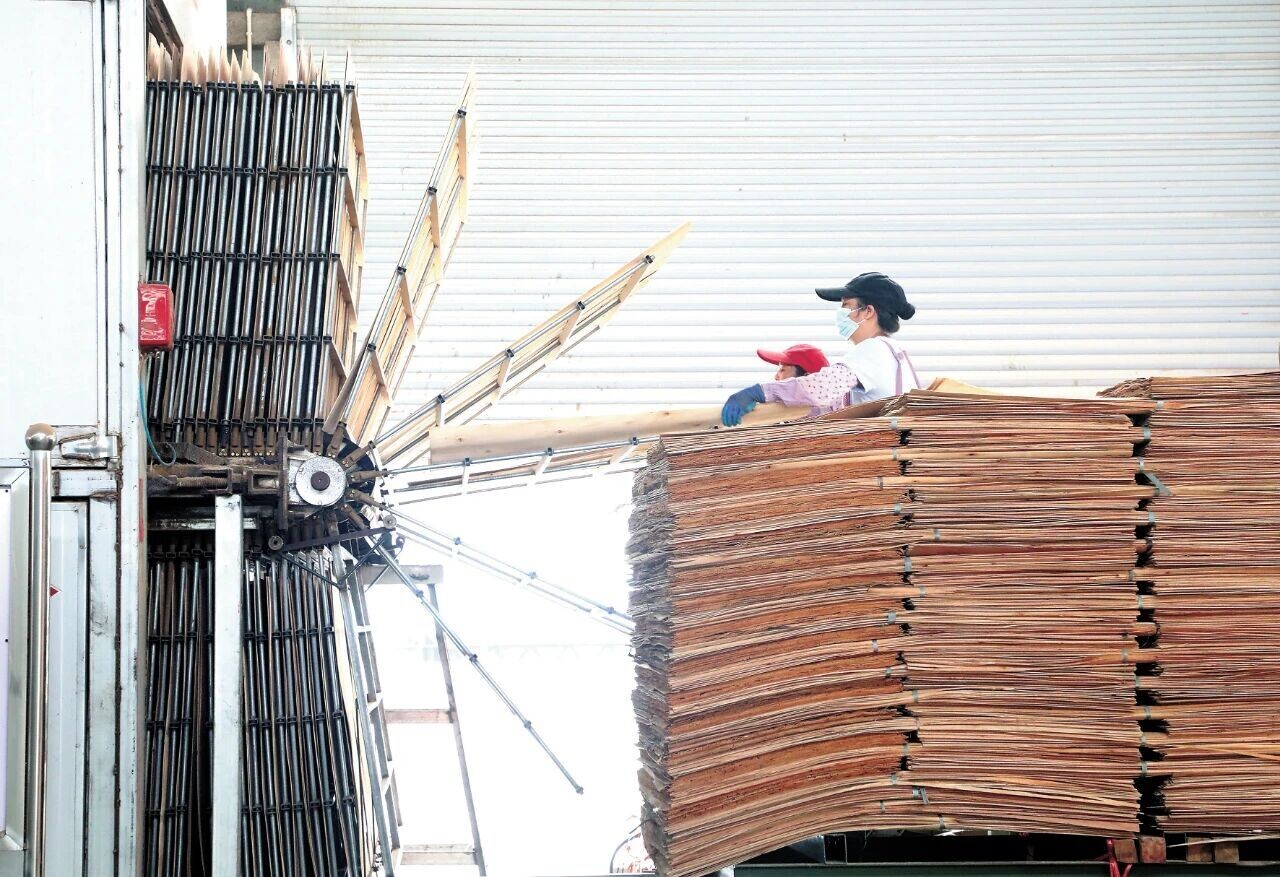
On June 5, workers were operating in the production workshop of Da Senlin Wood Industry Co., Ltd.
Why the industry is experiencing pain
"On livestreaming platforms, custom-made panel furniture is selling for 599 yuan, 499 yuan, or even 299 yuan per square meter." A representative remarked with emotion, "Product prices have been driven down to unprecedentedly low levels."
In the first half of 2025, revenue for furniture industry enterprises above a designated size declined by 4.9% year-on-year, while profits fell by 23% compared to the same period last year.
Currently, the engineered wood panel industry can be said to be facing both internal challenges and external pressures.
Internal structural imbalances exist. Due to low industry entry barriers and minimal product differentiation, a large number of companies are crowding into the same competitive space. When market demand declines, they commonly resort to price wars in an attempt to secure orders. As a result, the industry’s overall profit margins shrink, leaving businesses with insufficient funds for R&D and transformational upgrades, thereby trapping them in a vicious cycle.
The external environment is exerting pressure. As the real estate market enters a period of deep adjustment, new housing starts continue to decline, directly weakening demand for engineered wood products. This has further highlighted the issue of overcapacity, intensifying price competition.
And on the supply side, Particleboard The total production capacity reached a new high once again. In 2024, China completed and put into operation 48 particleboard production lines nationwide, adding an annual production capacity of 15.41 million cubic meters—making it the year with the highest-ever annual production capacity for China's particleboard industry. "At the beginning of this year, there were 30 particleboard production lines under construction across the country, with a combined annual production capacity of 10.15 million cubic meters," noted Zhang Zhongtao, a senior engineer at the Industry Development Institute of the National Forestry and Grassland Administration. "Meanwhile, particleboard production lines are currently underway in all seven major regions of the country." He added, "This has further heightened the risk of an imbalanced supply-demand relationship, compelling companies to accelerate efforts in exploring new product application scenarios and expanding their presence in overseas markets."
“Price should be based on safety and health as the top priority. Businesses shouldn’t compete solely on price—they should focus on building brand value and enhancing service quality instead.” Chengdu Meikang San Cedar wood Ye Changhai, the Chief Technology Officer of the industry limited company, resonated with the entrepreneurs present.
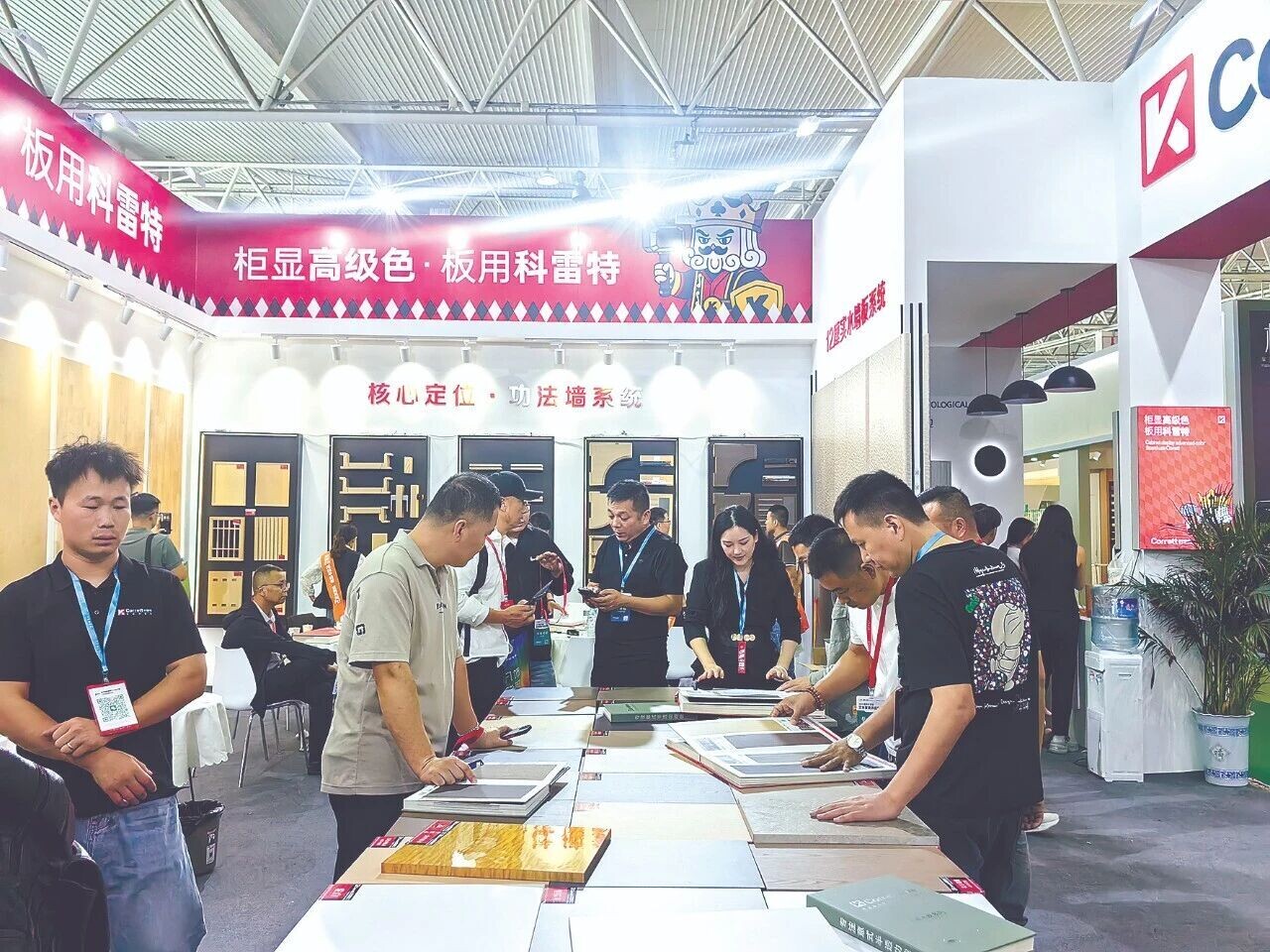
Linyi Wood Industry Expo Venue
On May 30, the mandatory national standard "Limit for Formaldehyde Emission from Indoor Decoration and Renovation Materials—Man-Made Boards and Their Products" stipulated that E1-grade man-made board products will be completely phased out starting June 1, 2026.
On September 24, six departments—including the Ministry of Industry and Information Technology and the Ministry of Natural Resources—jointly issued the "Work Plan for Steady Growth in the Building Materials Industry (2025–2026)," outlining goals such as achieving green building material sales revenue exceeding 300 billion yuan by 2026. On the demand side, initiatives like promoting green building materials in rural areas and aligning them with the development of "quality housing" projects are being leveraged to stimulate domestic consumption, enabling the engineered wood panel industry to deeply integrate into the growth of green construction and support the nation's dual carbon goals.
It is not difficult to see China's determination to eliminate outdated production capacity and optimize supply. Experts believe that, as these policies take effect, a new opportunity for improving the balance between supply and demand will emerge. Amid growing expectations of accelerated supply-side reforms driven by the "anti-involution" movement, the production capacity cycle is poised to reach an inflection point.
The "China's Man-Made Board Industry Report 2025" reveals that by the end of 2024, there were over 8,600 man-made board production enterprises nationwide, marking a year-on-year decrease of 14.9%. Meanwhile, the industry’s total annual production capacity reached 362 million cubic meters, representing an impressive year-on-year growth of 8.41%. Zhang Zhongtao noted: "Overall, China's man-made board sector is witnessing a trend of increasing production capacity, declining numbers of enterprises, and steadily rising average production capabilities among remaining companies. Behind these figures lies a qualitative shift as well—signaling that the industry is beginning to show signs of consolidation and modernization."
Rebuilding Core Competitiveness
High-endization, intelligentization, and green development are the inevitable directions for manufacturing growth, with the core essence being industrial upgrading.
Which direction to turn, and how to level up? The key lies in reshaping core competitiveness. At the meeting, leading companies shared practical insights and offered replicable pathways based on their own experiences.
A great board requires excellence both inside and out. According to the 2025 China Consumer Market Trends Insights Report, consumer demand is rapidly shifting from basic functionality toward personalized needs. Tian Maohua, Executive General Manager of Qian Nian Zhou Group, explained that the company is focusing on users' everyday living scenarios, continuously innovating technologies such as flame retardancy, moisture resistance, and bend resistance. As a result, Qian Nian Zhou has launched groundbreaking antibacterial board products featuring innovations like negative ions, photocatalysis, and graphene. At the same time, the group is expanding its presence with five state-of-the-art smart factories, equipped with three intelligent production lines. Today, the group has established a differentiated value system encompassing product value, service value, channel value, and social value.
Innovation-driven development is the key to industrial growth. Furen Group, responding to the demand for green and healthy living environments, has developed products such as Furen Bamboo Fragrance Boards, Furen Ship-Grade Boards, and Furen Bamboo Steel Plates. Lan Congrong, Chairman of the Group, explained that from bamboo forest management and timber processing to high-value utilization, the group has established a stable, convenient, flexible, and value-added, highly efficient, and premium-quality all-bamboo industry cluster. This cluster boosts primary-sector income by more than 300 million yuan annually.
Standards build a moat around enterprises. Ye Changhai says that, in addition to innovating and developing excellent products, companies must also use standards to solidify their new products and technologies—creating this "moat" of standardized excellence. To effectively leverage these standards, businesses should adopt an approach combining "innovation + standardization + cross-departmental collaboration + systematic adoption of industry benchmarks," ensuring that compliant products can command premium prices. At the same time, prioritizing patent protection is crucial for safeguarding innovative achievements and enhancing product competitiveness. "We must avoid repeating the mistake of breaking through technological bottlenecks only to find ourselves stuck again—this time by market constraints."
Expanding into New Market Segments. Liu Shouhua, General Manager of the Beijing Representative Office of Germany’s Diefenbach Machinery Equipment Co., Ltd., has identified fresh growth potential within Europe’s engineered wood panel industry. Over the past five years, OSB (oriented strand board)—a type of engineered wood panel—has stood out as one of the few segments in Europe with relatively stable production capacity and a clear upward trend. In 2024, Europe’s OSB production capacity is expected to increase by 5%, reaching a total output of 7 million cubic meters. Among this, OSB/4 accounts for 2%, OSB/3 makes up 85%, and OSB/2 represents 13%. In China, OSB is primarily used for interior decoration, with OSB/2 dominating at about 70% and OSB/3 accounting for roughly 25%. Meanwhile, OSB/4 remains largely untapped in domestic production. Liu Shouhua explains that this disparity stems from OSB’s versatile applications: in Germany, 72% of OSB is utilized in structural construction, while packaging accounts for 7%. "This is precisely the area where China’s OSB market has yet to fully penetrate," he notes. "Currently, China boasts robust exports of mechanical and electrical products, yet OSB is rarely employed for packaging purposes."
Adversity is also opportunity. As industrial structures undergo adjustment and consumer demand continues to upgrade—whether in the industrial sector, residential end-consumer markets, or initiatives like building "good-quality homes," as well as renovating dilapidated and aging housing stock—these shifts will undoubtedly usher in new growth prospects for the engineered wood panel industry.
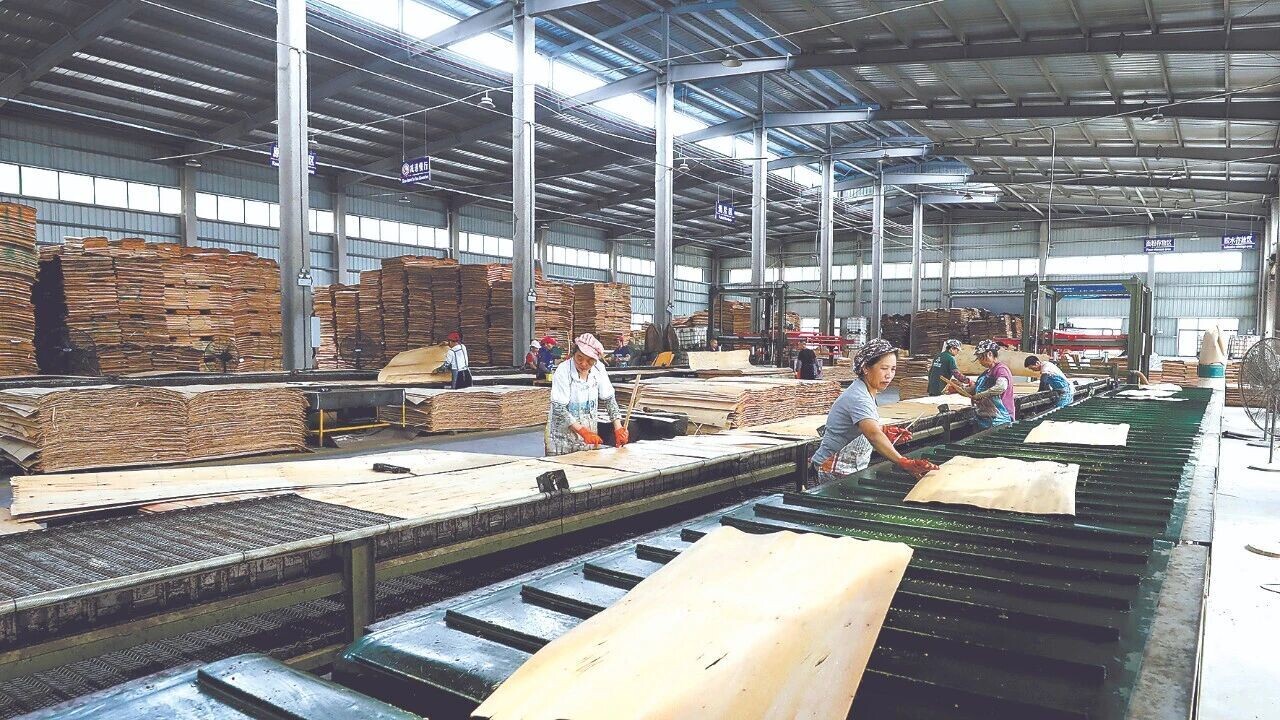
On August 12, workers were laboring in the production workshop of Guangxi Rongan Dashesen Wood Industry Co., Ltd.
Decoding the "Dual Carbon" Strategy
"Dual Carbon"—nearly 80% of the delegates at this conference addressed it.
The pressure to reduce carbon emissions is not unfounded.
The European Union's Carbon Border Adjustment Mechanism (CBAM) regulation came into effect on October 1, 2023. Starting from January 1, 2026, companies will be required to report annual carbon emission data for their imported products and pay corresponding carbon emission fees. Qian Xiaoyu, Chief Expert at the China Forestry Industry Association, explained that CBAM will gradually strengthen between 2026 and 2034, with its implementation pace aligning closely with the phasing out of free allowances in the EU Emissions Trading System.
The U.S. CCA uses the average carbon emission level of domestic products as a benchmark, imposing a carbon tax on both imported products and domestic goods that exceed this benchmark. Starting in 2024, a carbon tax of $55 per ton will be levied on the portion of emissions that surpass the baseline threshold, with the rate increasing by 5% annually thereafter. By 2026, the scope of the tax on imports will further expand to include downstream manufactured goods.
"Artificial boards are a green, low-carbon industry. Qian Xiaoyu explained: 'Wood is a natural carbon-storage material, and the carbon-emission levels during wood and wood-product manufacturing are lower than those in industries like steel and cement. In future sustainable development strategies, the artificial board industry has tremendous potential to contribute to achieving peak carbon emissions and carbon neutrality.'"
Advancing the "dual carbon" goals is not only about companies fulfilling their social responsibilities—it is also a strategic core issue tied directly to competitiveness. Businesses need to integrate green, low-carbon, and circular principles into every stage of their operations, from raw materials and production all the way through to the final product.
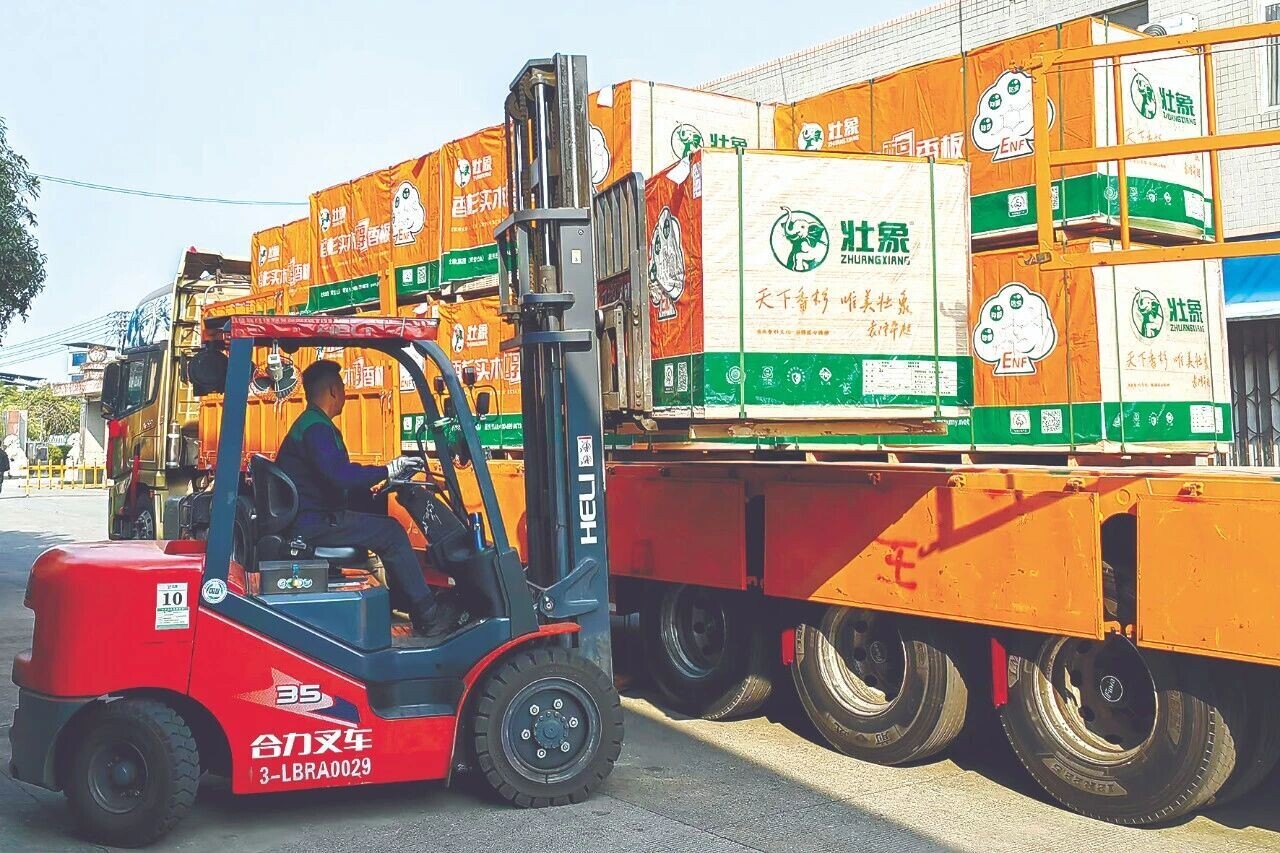
In January 2025, at Guangxi Zhuangxiang Wood Industry Co., Ltd., workers were loading and unloading fragrant cedar boards.
A stone from another mountain can be used to polish jade.
Large-scale enterprises can explore the practice of integrating forestry and panel production. Han Zhezhuo, Commercial Director of Kronospan China, explained that as a century-old manufacturer of engineered wood products, the group has established a comprehensive supply chain—from raw materials like timber to finished panel products—spanning forest plantations, particleboard plants, sawmills, and adhesive manufacturing facilities. Throughout this entire closed-loop system, the group is able to offset approximately 18 million tons of carbon dioxide annually.
Developing a "waste-to-wood" circular economy. Liu Shouhua explained that Europe prioritizes recycled materials—ranging from post-production scrap to other recovered resources—in its circular approach. Tray The proportion of recycled wood products derived from old furniture and wooden packaging increased from 45% in 2020 to 48% in 2024. In European particleboard production, the use of recycled materials has helped conserve nearly 9.8 million oven-dry tons of virgin wood. Notably, in Italy, 98% of particleboard raw materials come from recycled sources. Diefenbach GmbH, together with partners from seven countries, has successfully secured an EU loan project focused on recycling and reusing waste wood. The project has already achieved significant progress in transforming discarded wood into valuable resources. Fiberboard China is recycling fibers and repurposing them for the production of fiberboard. Liu Shouhua stated, "This technology has successfully passed approval and has secured funding support from the European Union. Currently, customers have already begun placing orders." Over the next three to five years, the utilization of recycled materials will accelerate its widespread adoption. Companies that proactively establish recycling systems and invest in related technologies will gain a competitive edge in the green economy.
Qian Xiaoyu believes that eco-friendly technologies, digital production, and functional innovations are the core competitive advantages of the engineered wood panel industry. Looking ahead, regional market differentiation will coexist with global expansion, and the increasing industry concentration will reshape the competitive landscape.
Disclaimer: All content marked with a source indication is either a repost or officially registered and published by corporate users. Our website reprints these materials solely for the purpose of sharing more information. If the reposted articles or images raise copyright concerns, please contact us directly for removal. Additionally, regarding user comments and other such content, our website does not necessarily endorse their views or verify the accuracy of their statements.
Contact Us
7th Floor, Taihe Huayu, Zhengyang Road, Shouguang City, Shandong Province
Daotian Town Government, Shouguang City, Shandong Province

LEAVE A MESSAGE
Online consultation